Wednesday, 5 August 2020

Contact tracing apps: a brief overview

A recent query forced me to update my understanding of contact tracing apps as used (or not!) during the current pandemic. I found resources such as these from The Register and the BCS helpful in gaining a rapid understanding. More recently, Claudia Pagliari has reviewed the ethics of contract tracing apps. Here's my brief summary:

Different countries have adopted different approaches to contact tracing. In some, GPS location tracking is used to establish when people were collocated. In others, QR code solutions, that record when people check in and out of buildings, can identify who was in the same building at the same time, but not whether they were ever in close physical proximity. Both these approaches may compromise people’s privacy as they depend on centrally storing data that identifies the phone, location, and time. Their technical effectiveness relies on the precision and accuracy of the data and the reliability of the matching algorithm that identifies collocated people.


A third approach, facilitated by Apple and Google, is decentralised. Put simply, this relies on Bluetooth connections between devices: devices exchange IDs (and potentially distance, inferred from signal strength). If the owner of one of the devices subsequently reports a positive test result then notification is sent to all phones for which the IDs have been stored within the past 14 days. This avoids recording location and is better for respecting individuals’ privacy; it also limits the utility of data for other purposes such as public health research.

The practical effectiveness of any solution depends on how many people adopt it (60% of the population is a widely used figure) and on people being collocated with their phones; some countries achieve this through regulatory means (e.g., by controlling people’s right to travel); others rely on “public spiritedness”.


All approaches rely on the accuracy and timeliness of reporting test results, and on the quality of app programming. Another potential limitation of contact tracing apps is that while different regions adopt different solutions, each only applies locally, and may be undermined by international travel.


In summary, there are many obstacles to implementing an effective contact tracing app that respects individual rights as enshrined in the laws of many countries. A well designed and deployed app may reduce infection rates but no app will eliminate Covid-19 without other, complementary, interventions.

Sunday, 3 May 2020

Extraordinary experiences (April)

Another month of lockdown, and a few new experiences (see previous posts), of which the most challenging was my mother being hospitalised. Her presenting symptoms were very low blood pressure (postural hypotension) which was resulting in falls, plus fluctuating temperature. Neither paramedics nor her GP thought it was Covid, but when she got to hospital she tested positive, so was transferred to a Covid ward. We had been unable to visit her for several weeks, but had been able to see her over FaceTime, and had created a youtube playlist for her carers to share with her so that she could see our faces and hear our voices at other times too.

Losing even that level of contact with her was hard. What was even harder was the sense that, as her attorneys for health and welfare, we would have to make decisions about what interventions she would receive if her health declined further. We braced ourselves for the worst while hoping for the best (though everything on the news leads one to expect the worst). Being unable to visit, we were entirely reliant on reports from the nurse responsible for her care at any given moment. Fortunately, we didn't have to make any hard decisions because her health gradually improved and she was discharged after 9 days.

Each day, I called at what I thought would be a convenient time for them. Occasionally, the designated nurse was available to talk; more often, I had to try multiple times (6 or 7 on some days) between work meetings to catch them: I don't know how many patients each nurse was responsible for, but obviously they were doing full barrier nursing, with all that means in terms of changing PPE after seeing every patient. After the first 2-3 days I gave up asking for medical details such as temperature or blood pressure or what medications she was on because it took so long for the nurse to access the notes (either paper or on the electronic record) that the costs to them of doing so outweighed the benefits to me of having a full picture of her progress. So I just heard the things that they could easily remember: whether she was up or in bed, how well she was eating, whether she was singing. I think when Mum stops singing, that will really be the time to worry!

I'm very grateful to the different care teams (and support staff) looking after Mum in both hospital and the care home, but the Covid situation brings into sharp relief  how essential those people are to mediate between family and people like Mum, who can't use any technology for communication themselves. That creates a really narrow channel of communication.

In other news: the bluebells have been beautiful this year, and I think we've now explored every possible track within a couple of miles of home. According to my health app, my average step count in April is the highest since recording began - presumably because I'm making a specific effort to get out for my one precious walk a day (and can't do things like climbing which don't contribute to the step count).

I'm learning a lot about the human body through the process of doing two sessions a week on it (remotely) with the grandsons. We're particularly enjoying Operation Ouch and Kahoot! quizzes. I have also learned to be a barber, but won't be taking it up as a profession.

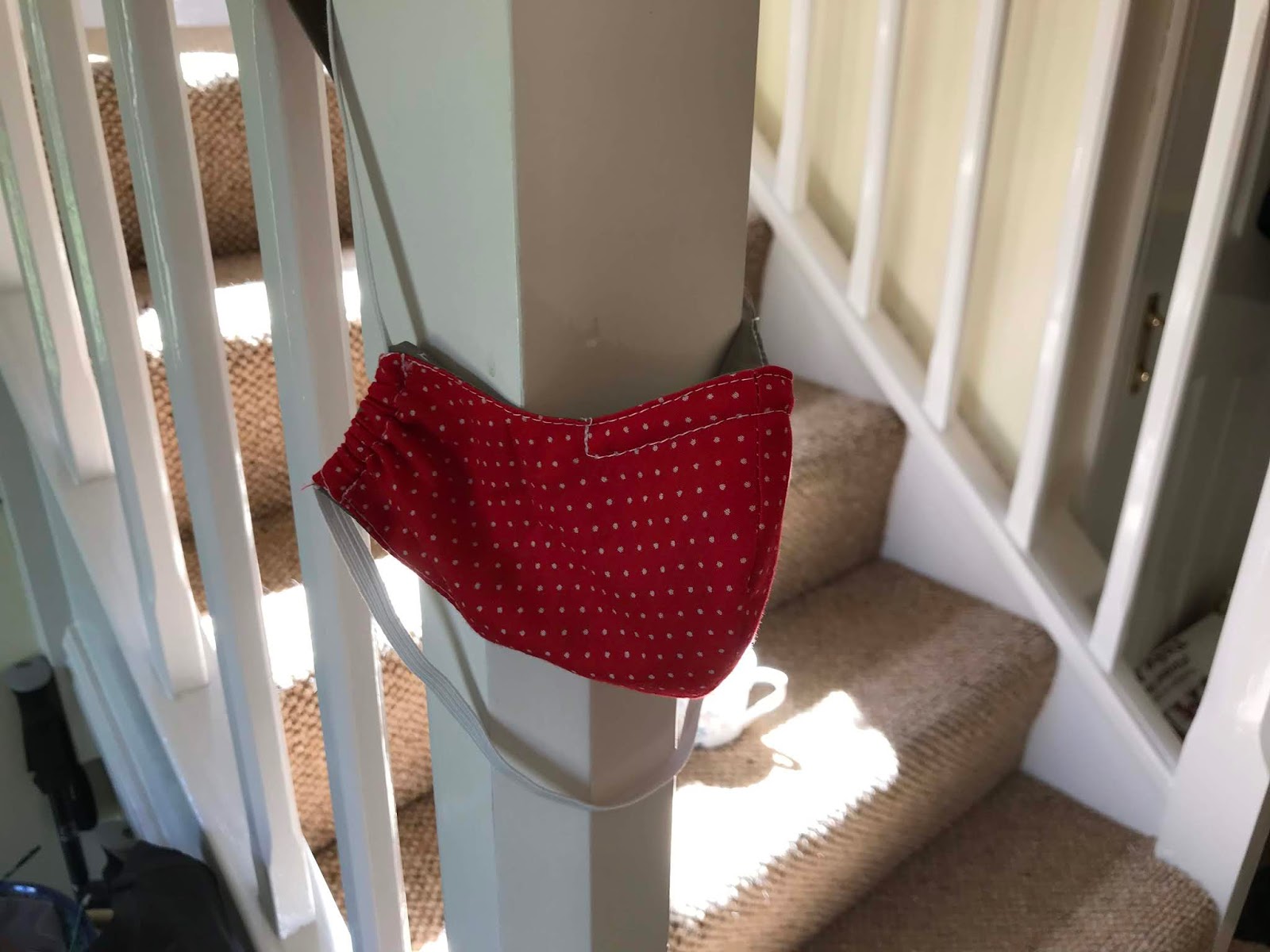
Work continues, and continues to be demanding. Students, research team and colleagues mostly seem to be adapting well to the changed demands and circumstances. The latest non-work activity is making reusable face masks for all the family. The first one was made from scraps of fabric that we had lying around, and looks more like a bikini top made by someone with a poor awareness of the normal female form, but if it helps reduce spread, who cares? I've just made ones featuring Pikachus for the boys and am tempted to make one of those for myself...


Saturday, 4 April 2020

Extraordinary times (week 3)

I suspect that this might be my last blog post on the lockdown, unless (or until) something catastrophic happens to family, friends or myself. Things feel as if they are settling into a new routine. [Postscript: a post about April mostly features my Mum being in hospital.]

We are keeping in touch with family and friends a little-and-often: quantity compensating to some extent for lower quality (I really, really miss hugs). I particularly miss outings with my mum (who has dementia): it's hard to keep an online conversation going for long with someone who has little memory and is persistently singing "Yankee Doodle" or "London Bridge" at the other end, whereas it was relatively easy to chatter about things in the environment on an outing.

As I noted last week, online Pilates works pretty well. Zumba is more challenging, but also more fun: who says you can't dance badly in your own living room? I haven't found an adequate online or home-based substitute for climbing. We're lucky that there are lots of footpaths and lanes near our home; we're exploring places we've never discovered before within a mile of home. The spring flowers are looking lovely, and bluebells will be out soon.

With no more university teaching for a while, it's been more meetings than classes. An online PhD viva worked surprisingly well, though I think it was more stressful for everyone than a normal face-to-face one (and that's stressful enough!). I'm learning to schedule gaps between meetings, and also a lunch-break, because these now have to be scheduled. Face-to-face, comfort breaks can be negotiated informally in-the-moment, but that's much harder to do online. Basically, working from home is more intense, particularly when it's back-to-back meetings. And particularly when those meetings involve rethinking all the plans we had for the next several months (no face-to-face interviews, no observational research...).

It still seems very surreal, knowing that the current situation is really challenging and distressing for many while it's actually just a bit weird for us. But it seems like a "new normal", at least for a while.

Saturday, 28 March 2020

Extraordinary times (week 2)

I already noted key experiences from the first week of enforced working from home. At that time, we could still go out. This week, it has been lockdown, with just one walk a day and essential trips (mostly food shopping). The weather has been bright (if a little chilly) all week so it has felt surreal: everything feels fine, almost like a staycation, and yet things are so much more difficult for many other people:
  • the healthcare professionals (including paramedics, porters, cleaning staff, teachers of key workers' children...) who are keeping the healthcare system functioning and putting themselves at risk for all of us.
  • the people delivering essential services (including food, refuse collection, internet and more) so that it can feel like a working staycation for those of us working from home.
  • people who find themselves in isolation or separated from loved ones or stuck in the wrong country as borders closed.
  • people whose income has dried up, whose businesses are threatened, who aren't sure how they will pay the bills.
  • parents now managing home schooling on top of everything else, and/or people supporting eldery relatives who are living independently.
  • and of course people who are having to deal with the worst of Covid-19, experiencing the loss of family or friends or feeling like they have been "hit by a train" (can't remember who described it like that) themselves.
So it seems like the best way to apply my skills is to maintain "business as usual" for the students and colleagues I work with. And to stay at home to do that. In many ways it has been a mundane week.

Monday's teaching was challenging. The topic was "global healthcare" – I could not have anticipated quite how we would be viewing this topic when I planned it six months ago. I could record the lecture ahead of time, but I really wanted the students, particularly those who had experience of other healthcare systems, to share their insights. But with over 30 students joining remotely, some with very dodgy internet connections, it was impossible to involve them all, even though I'd included a "google slides" document for people to contribute key points. It all got particularly stressful when my own connection got flaky and kept dropping the audio channel. About three weeks ago, I lost my voice (laryngitis) in class, and now my internet connection was delivering virtual laryngitis. And I still haven't worked out how to make group discussions work well with 30+ participants spread around the world.

We did our first sessions of remote yoga and Pilates at home.  All furniture pushed to one side.It worked amazingly well, probably helped by the fact that we knew the teachers and most of the moves pretty well already.

On Tuesday, I had my first remote teaching session with the grandsons. The older one was keen to learn; the younger was just tired. Kahoot! quizzes were great, though I've found that creating ones tailored to the children are better than using other people's quizzes. When I invited them to do and show me a drawing it was challenging to see it, particularly since they weren't sure where the camera was at their end. But we can learn and get better. This week, the themes will be rainbows, light and eyes.

On Wednesday, I chatted with my mum over facetime. She was out in the garden, enjoying the sunshine, and seemed happy. But the sun shining on the screen meant that she couldn't really see me, so it was more like a phone call than video. I remain relieved that she is in good hands.

On Thursday, I was teaching a smaller group who all seemed to have reasonable internet connections. We shared photos and sketches of multimodal interactions in our homes, from ovens and toasters to toothpaste tubes (since we couldn't access a surgical simulator, which was the original plan), and it worked really well. I'm still not sure what the surgical equivalent of toothpaste is, but I'm sure there must be one.

That evening was the first online Zumba class. This didn't work as well as the Pilates because the Zumba experience depends more on the sense of other people around one, and also requires more space, but it was still lovely to dance like no-one's watching. Which they weren't (since I had to turn the video off to maintain the internet connection).

So it seems that people who are afflicted by Covid19 are reliant on the health service while those of us who are fortunately well so far are reliant on our internet service providers. Plus food and loo rolls. Thank you to all!

There's a short update about week 3. Things are becoming normalised until there's a major change...

Monday, 23 March 2020

Extraordinary times

Two weeks ago (Monday 9th March), I stood at the front of a class and said "In the unlikely event that UCL closes before the end of term..." and within a week all face-to-face teaching had been cancelled. Such is the experience of exponential change. I know I'm not alone in realising that views I held a matter of days ago were untenable. I am guessing that this process of revising beliefs and attitudes isn't over yet.

The last day I was in the office was just two days after that wildly incorrect assessment. I'd planned to work at home the end of that week anyway. Since I work at home quite often I was already set up for most things, but there were a few items I hadn't brought home. The most critical turned out to be my interoperable collection of "so 1990s" Filofaxes. I ordered one. I've lost continuity in my note taking, but by asking all my team to remind me what we'd agreed in our previous meetings I'm catching up quickly. Home delivery worked brilliantly too.

Improvised desks are sprouting up in our house, such as a standing desk made up of an old bookshelf with a small "laptop desk" which is located right next to the wifi router for use during the more critical online meetings.

I had to do a rapid rethink on all my teaching: lectures got recorded ahead of time so that I wasn't totally reliant on our home broadband at the critical time (that worked easily once I'd mastered the uploading software for the virtual learning environment). Class quizzes worked well remotely. Class discussion with over 30 students was challenging. When I had a smaller class a few days later, I mercilessly brought each student into the discussion, keeping a list of who had contributed and who hadn't yet. Not as good as face-to-face, but not bad either.

This coming week, I'd have liked to do a discussion exercise with digital postits in class. I considered several alternative tools for this; some required too much set-up for a single session; some work better asynchronously than in real time; I've ended up just sharing an online document that all students can contribute to, and we'll see whether we can build a discussion around that. It's all a bit of an adventure.

Many of our MSc students are having to rethink their projects for this summer because we have to assume they won't be able to travel or to do any collocated data collection. That's yet another challenge. But at least we can all access library resources from our homes because of all the work that has been done to make them remotely accessible.

I seem to be spending most working hours in online meetings. Many of these work as well as traditional meetings. More importantly, we're using the same videoconferencing technologies for social events: for sitting around in the evenings with friends and family – not just one-to-one like phone calls, but collecting in groups, socially close while physically distant.

None of this would have been possible, even a few years ago. Even if the foundations of the Internet were established in the 1960s and the early World Wide Web around 1990, the tools that we're now using on top of these structures have all been developed within the past few years. And they are getting easier to use and to fit into our lives very rapidly.

If SARS-COV2 had emerged three years ago, I don't know how we would have dealt with ageing parents who believed that they could live independently but actually needed a lot of support (to which they were unrelentingly hostile). Since then, my father has died and my mother is now in a care home, living with advanced dementia. I wouldn't want to visit (even if permitted) for fear of passing on COVID-19 to the wonderful residents or staff. So last week we tried using FaceTime to chat (with support from Jo the manager). I wasn't hopeful that Mum would engage at all, but she seemed to recognise me (at least as a close female relative, if not necessarily as her daughter). We had a good few minutes' surreal chat interspersed with Mum singing then, as I made to say goodbye, she leant forward and kissed the phone. It was strange, and yet poignantly lovely to have this kind of connection when we can't be together. Even if both the phone and Mum's lips then needed a clean!

On Friday, we had a take-away. It seems important to support our local restaurants as they are forced to close and take-aways are the only option. I wonder whether it will continue to be a safe option at all in the coming weeks.

Schools closed on Friday (20th March), which is going to add to the stresses of our children continuing to work while also home schooling. Family have been recruited as remote teachers. Granny will be doing reading and writing; Grandad is starting with some "horrible history"; Auntie will be teaching French; and I'm concocting some science lessons. If we thought remote teaching of students was challenging, remote teaching of small boys ia likely to be substantially more so, but at least it will mean regular contact, and we'll all learn something new in the process.

There are also lots of online classes sprouting up: I'm looking forward to yoga and zumba this week even if they will require us to reorganise furniture even more (in addition to the improvised desks) to make space to move.

We know we are really lucky: we can work fairly effectively from home and we have a garden for fresh air. Mum is safe and well looked after; the rest of the family are all well so far, even if the youngsters are restless. We are aware that many other people have much greater challenges and stresses and grief to deal with. I am truly grateful to all key workers: in healthcare and in keeping essential services (including food, medication and internet provision!) available.

Footnote: Week 2 was still a period of adjustment...

Sunday, 9 February 2020

"When I get older..."

The topic of "healthy ageing" is seen a very important. For example, in the UK, there is a challenge of "5 extra healthy years by 2035". It's not clear how that will be measured, or indeed whether it means 5 extra years of life (that will be healthy ones) or targeting improved health within the current lifespan.

At UCL, we had a panel discussion on this theme at the 2019 annual symposium, and the House of Lords Science & Technology Committee is currently conducting an Inquiry into Ageing: Science, Technology and Healthy Living. I had the interesting experience of appearing before this committee last week. The discussion was wide-ranging, but inevitably didn't cover all the themes that are important: it's a huge topic!

Here are a few themes we didn't talk about that I think are important in this discourse:
  • Expectations of ageing. There isn't a single experience of ageing. Yes, there can be challenges, such as cognitive impairments (e.g., dementia) and managing multiple morbidities, but this isn't a universal experience. For example, Angela Soper and Ivor McCourt are both climbing at a high standard in their 70s, and many people have great fun as they age, whether it involves demanding physical activity or not.
  • Wisdom has a value that complements the qualities of younger generations, and most people have valuable things to contribute to society, provided that structures are in place to empower people to contribute in whatever ways they can.
  • There isn't a single date on which we become "old", and good design should be accessible to most people regardless of their age. Indeed, people are likely to find a technology useful in older age if (a) it doesn't carry a stigmatising label of being "for older people", and (b) it is something that they have found useful for some time (and are familiar with).
  • Theories such as Self Determination Theory highlight the importance of experiences such as autonomy, competence and relatedness in contributing to quality of life. Autonomy and competence can be promoted or diminished through technology design and the infrastructure that surrounds it. For example, local government services that can only be accessed digitally without providing support for people with limited digital skills are disempowering. Conversely, technology that is easy to use and that gives people access to services they might not be able to access otherwise is empowering.
  • Loneliness is one of the most important factors in poor quality of life and cognitive decline in older age. This is predicted to be a growing problem in the UK, and loneliness is associated with mild cognitive impairment (MCI) and dementia. Poorly designed technology and infrastructure contribute to loneliness, but there are some great opportunities to design technologies that bring people together and increase people's sense of connectedness.
Designing for people of all generations is just that: designing for people, recognising that everyone has their abilities and their needs. There's a quotation that goes something like: "Growing old isn’t so bad when you consider the alternative." For some people (e.g., in pain or managing dementia), this might not be true, but hopefully appropriate technologies can help to make later stages of life a positive experience for many people. So can cliffs and swings and other "low tech" stuff!

Image by Claudia Peters from Pixabay

Wednesday, 27 November 2019

Schrodinger's striking academic

Once again, academics find ourselves in dispute with our employers. And yet again, many of us feel very conflicted about this. I am currently making sense of the alternative "possible worlds" in which I live by thinking of myself as Schrodinger's striking academic.


As long as no-one looks too closely, I am striking and not-striking simultaneously.
It depends on when you look as to whether I am striking or not striking.
Unlike the cat, the transition can go both ways.
I am striking because universities need to manage workloads, promote equality, minimise precarity. We are not cogs in a machine to be worked ever harder: we’re at breaking point.
I am not striking because students aren’t items on a production line. I care about their progress.
I am striking because pay and pensions need to keep up to attract the next generation into a demanding career.
I am not striking because my day-to-day work is not visible to my managers. This may be “industrial action”, but academic inputs and outputs are not tightly coupled.
I am striking because it seems that this is the only way to encourage management to listen.
I am not striking because, based on my employer’s standard working week, I had worked my hours for 2019 by 5th September. I’m not sure what it means for my employer to withhold pay when I’m working for free anyway.
I am striking because I am standing on picket lines, not crossing picket lines… even if I am then doing a full day’s work from a location off campus.
I am not striking because I have deadlines and there isn’t the slack in the system to catch up later. See note on workloads. No-one else will look after my mental health, so it’s up to me.

I know I am not alone, but that doesn't make the ambiguity any easier. Here's hoping for progress soon...

Image by Gerd Altmann from Pixabay

Monday, 25 March 2019

Don't forget!

Our mother has advanced Alzheimer's disease. Our father had vascular dementia. For a long time, we found it difficult to locate resources that helped to understand the diseases, our parents' experiences, or what we (as their children) could do to support them. We found quite a lot of material that was patronising, overly general, or overly technical.

The following are some of the resources that I have found most helpful to date (in no particular order):
  • Wendy Mitchell's personal narrative of her experience of early onset Alzheimer's gives an amazing insight into the challenges and strategies that one person established to overcome them.
  • There are many variants of dementia, with different causes and patterns of progress. These are well summarised by Dementia Australia.
  • Alzheimer's disease is the most common form of dementia. This article in Nature Education gives some insight into the specifics of AD.
  • Five "pocket" (i.e., brief!)  films about aspects of Alzheimer's capture the science in neat little chunks.
  • The Dementia UK site gives more insight into managing and living with AD. Follow links from there to find out about other kinds of dementia.
  • A personal narrative by a child of someone living with dementia emphasises the value of good care homes and their specialist care.
  • As someone loses abilities, it's useful to find products that are specifically designed to support (and bring pleasure to) people with dementia, such as Unforgettable.
  • In the UK legal aspects of supporting someone with dementia include setting up legal power of attorney while they still have mental capacity to do so, and possibly applying for attendance allowance to help towards the cost of care when it becomes necessary.
Maybe one day I'll link these notes to theory of information seeking, but for now it's just a place to gather some links.

Saturday, 22 December 2018

Artificial (Un)Intelligence in healthcare

I've recently read Meredith Broussard's "Artificial Unintelligence". It's a really good read on both the strengths and the limitations of AI technologies. It is so important to talk about both what AI technologies can do and also what they cannot -- whether that is "cannot" because we haven't got to that point yet or "cannot" because there's some inherent limitation in what technology can offer. For example, in healthcare, technology should get better and better at diagnosing clinical conditions based on suitable descriptions of symptoms together with a growing body of relevant data and more advanced algorithms. The descriptions of symptoms are likely to include information in multiple modalities (visual information, verbal descriptions, etc.) while data are likely to include individual data (biomarkers, patient history, genetic data, etc.) and population data (genomic data, epidemiological data, etc.). Together with novel algorithms, these should get better and better at diagnosis. However, it's unlikely that technology is ever going to be able to deal with some of the complex and subtle challenges of healthcare: making people feel cared for (such as giving someone a meaningful hug), creating the social environment in which it's acceptable to talk through the emotional factors around stigmatised health conditions, etc.

At the Babylon Health event on their AI systems and vision in June this year, there was a lot of emphasis on diagnosis and streamlining care pathways, but conspicuously little on addressing the needs of people with complex health conditions or the broader delivery of care. There was, incidentally, an unnerving moment where an illustrative slide included the names of an entire research group from a London university who I happen to know, suggesting a cavalier approach to data acquisition and informed consent. But that's another story. Many concerns have been raised about the "GP at Hand" model of care delivery, including concerns about equality of access to care, the financial model, the validation of the algorithms used, and the poor fit between the speed of change in the NHS and that required for tech entrepreneurs; some of these issues were covered (though without clear resolution) in a recent episode of Horizon on the BBC. Even more recently, Forbes has published an article on some of the limitations of AI in healthcare – in particular, the commercial (and publicity) imperative to move quickly, which is inconsistent with the safety imperative to move carefully and deliberately. There is a particular danger of belief in the potential of a technology turning into blind faith in its readiness for deployment.

One of the other key topics Broussard talks about "technochauvinism" (the belief that technology is always the solution to any problem). We really need to develop a more robust discourse around this. Technology (including tech based around huge datasets and novel AI algorithms) has really exciting potential, but it needs to be understood, validated, tested carefully in practice. And its limitations need to be discussed as well as its strengths. It's so easy to be partisan; it seems to demand more of people to have a balanced and evidenced discourse so that we can introduce innovations that are really effective while finding ways to value and deliver on the aspects of healthcare that technology can't address too.

Wednesday, 28 November 2018

Palliative care technology (professional interest meets intensely personal experience)

About 10 years ago, when I first started working on infusion devices, I met a medical director who did a lot of work in hospices; he noted that the motors in the syringe drivers in use at that time hummed gently while delivering medication, and that many families hated the constant reminder that this meant that their loved one was on end-of-life care.

Recently, I have experienced this at first-hand, except that the syringe driver being used was mercifully quiet, and did nothing to remind us of its presence. It only really featured when Dad (now very peacefully sleeping) had to be turned to a different position, when the care professionals had to take care not to occlude or dislodge the line. And yet this simple device had huge emotional import: it still, silently, announced that the end of a life was near. It was exactly the ending that we had agreed we would want if possible: peaceful, not disrupted by any invasive or disruptive interventions, with family around. And yet I still found myself wanting to remove the driver because it signified a conscious decision, or determination, that Dad was indeed going to die. Maybe if I removed the driver then Dad would spring back into life. So I find myself with very mixed emotions about the driver: gratitude that it did indeed contribute to a peaceful, pain-free ending combined with distress that it announced and determined the inevitability of that ending.

As a technology professional, I of course also found the device interesting: the nurse who set it up did so with great care, and clearly found it easy to use: it is a task she performs routinely. But the three aspects that we highlight in our paper on "Bags, Batteries and Boxes" all came up in the conversation around the driver. The disposable bag provided was identical to the one featured on the left in Figure 1 of our paper (though all it did was notionally hide the driver which was, in any case, hidden under the sheet). The nurse replaced the battery at the start and after 24 hours to minimise the risk of it running out of charge. The box was locked to prevent tampering (correct) but, bizarrely, when it came to removing the driver after Dad's death, I was the only person in the room who knew where the key was located, which rather undermined its role as protection against tampering. Since no nurse visited after Dad's death and I didn't want him to be moved while still attached to said driver, I asked the doctor to remove the butterfly needle. Clearly, the doctor had never done such a thing before, reinforcing findings from our study of incident reports involving syringe drivers used in private homes that doctors are sometimes put in the position of having to use technology they have no familiarity with. Thankfully, the doctor did kindly remove the line, gently as if removing from a living patient, and we could send Dad off suitably clothed and unencumbered by redundant technology. I can only assume that the driver was returned to the community nurse team later.

I'll close by thanking the amazing staff at Tegfield House, who cared so diligently for both Dad and us and the equally amazing NHS nurses and doctors who cared for Dad over many years, and particularly in his final hours.

Monday, 25 June 2018

Happy 70th birthday (to digital and to the NHS)!

It's been widely publicised that it's the 70th birthday of the NHS on 5th July this year. When preparing to be interviewed for a Telegraph podcast on digital health, I realised that it's also the 70th birthday of the "Manchester Baby", the first stored program computer (21st June). So in a very real sense, the parentage of digital health in the UK was born 70 years ago. There are other relevant birthdays to celebrate too, such as the 60th of the Human Factors Journal (for which usable health technology is an important theme) and the 500th of the Royal College of Physicians.

Manchester baby head onWe've come such a long way in 70 years. Many of the major advances in that time can be attributed to a better understanding of hygiene and antibiotics, and to pharmaceuticals more generally. As advances in pharma are becoming more costly, digitally enabled health and wellbeing are likely to provide greater gains.

The history of analogue medical devices goes back hundreds, or even thousands, of years. For example surgical knives are believed to date from Mesolithic times (8000BC), syringes from the 1500s, and the first stethoscope from 1816.  

There have been transformational developments in digital health technologies from the 1970s onwards. People may find it difficult to remember back to the times when there was no such thing as intensive care (as we now understand it) but it has emerged within our lifetimes: critical care medicine, with its focus on continuous monitoring and intervention, was established in the late 1950s. Imaging is another area that has grown in significance from x-rays – largely since the 1970s, when Computerised Tomography (CT scans) and Magnetic Resonance Imaging (MRI) were introduced. Now computing is fast enough that it is becoming possible to use imaging in real time during surgery, and to introduce interactive 3D images (built up from 2D slices).
 
These are part of another phase of rapid developments which are also being brought about by the availability of consumer devices, including wearables, that are becoming accurate enough to substitute for professional devices. Also, big data; for example, genomics is improving our understanding of the interrelationships between genes and their combined influence on health, while consumer genetic testing kits are making new health-relevant information available to the individual.

As the digital computer and the NHS reach their 70th birthdays, we are seeing huge advances in the technologies that address relatively simple problems. However, we have made much less progress in the technologies for complex problems. Go into any hospital and look at the complexity of the systems clinicians have to use – e.g. 20-30 different interactive technologies on a general ward, all with different user interfaces, all of which every nurse is expected to be able to use. From a patient perspective, someone managing multiple health conditions has to integrate information between the different tools and specialisms they have to engage with. We are seeing growing friction as what is theoretically possible slips past what is currently practicable.
 
What do the next 70 years promise? It is of course hard to say. A paperless NHS? – probably not by 2020, but maybe by 2088. Patient controlled electronic health records? – maybe if people are appropriately educated and supported in managing the burden of care; this will require us to address health inequalities brought about by differentials in income, education, technology literacy, health literacy, etc. The huge challenge is not the technology, but the individual and social factors, and the regulations, around it. This will require a new approach to data privacy and security, funding models and regulations that are fit for the 21st century, and education for clinicians, technologists and the public to ensure these changes are beneficial for all.
 
Of course, the NHS is just one healthcare delivery organization, amongst many globally. Some other health providers are doing things on a shoestring but overtaking the West in many ways by being agile – e.g., investing straight in mobile technology.
 
However, whatever advances we see in technology, care is still first and foremost about the human touch. The technology is there to support people.

Sunday, 18 March 2018

Invisible work

I have been on strike for much of the past four weeks – at least notionally. The truth is more nuanced than that, because I don't actually want my students and other junior colleagues to be disadvantaged by this action. I am, after all, fighting for the future of university education: their future. Yet I do want senior management and the powerful people who make decisions about our work and our pensions to be aware of the strength of feeling, as well as the rational arguments, around the pensions issue.

There have been some excellent analyses of the problem, by academic experts from a range of disciplines. Here are some of my favorites (in no particular order):
As well as standing on picket lines, marching, discussing the issues around the strike, and not doing work that involves crossing said picket lines, I have continued to do a substantial amount of work. It has made me think more about the nature of invisible work. Bonnie Nardi and Yrjo Engestrom identify four kinds of invisible work:
  1. work done in invisible places, such as the highly skilled behind-the-scenes work of reference librarians; to this I would add most of the invisible work done by university staff, out of sight and out of hours.
  2. work defined as routine or manual that actually requires considerable problem solving and knowledge, such as the work of telephone operators; don't forget completing a ResearchFish submission or grappling with the Virtual Learning Environment or many other enterprise software systems.
  3. work done by invisible people such as domestics, (and sometimes Athena SWAN teams!)
  4. informal work processes that are not part of anybody’s job description but which are crucial for the collective functioning of the workplace, such as regular but open-ended meetings without a specific agenda, informal conversations, gossip, humor, storytelling.
The time for (4) has been sadly eroded over the years as demands and expectations have risen without corresponding rises in resourcing.

To these, I would add the invisible work that is invisible because it is apparently ineffectual. E.g., I wrote to our Provost about 12 days ago, but I have no evidence that it was read; it certainly hasn't been responded to in any visible way (reproduced below for the record).

The double-think required to simultaneously be on strike while also delivering on time-limited commitments to colleagues and students has forced me to also develop new approaches to revealing and hiding work. For example, 
  • I have started logging my own work hours so that the accumulated time is visible to me, and although I've been working way more than the hours set out in the Working Time Directive, I'm going to try to bring the time worked down to comply with that directive. This should help me say "no" more assertively in future. That's the theory, at least...
  • I have started saving emails as drafts so as not to send them "out of hours". There are 21 items in my email outbox as I type this; I'll look incredibly productive first thing on Monday morning!
And finally, I will make visible the letter I wrote to the Provost:


Thank you for this encouraging message last week. You are right that none of us takes strike action lightly. We all want to be doing and supporting excellent teaching, research and knowledge transfer, but we are extremely concerned about the proposed pension changes, and we have found no other way to be heard.

I’ve worked in universities since 1981 and this is the first time I have taken strike action. The decision to strike has been one of the harder decisions I have taken in my professional career, but I think the impact of the proposed pension changes on our junior colleagues (and hence on the future of universities) is unacceptable, and I am not persuaded that a DB scheme is unaffordable.

Please continue to work with the other university leaders to find an early resolution to this dispute. UCL isn’t just estates and financial surplus: as you say, it’s a community of world-leading, committed people who work really hard, and who merit an overall remuneration package that is reflective of that. That includes pensions that aren’t a stock market lottery for each individual.

I’d like to be in my office meeting PhD students and post-docs next Monday morning, and in a lecture theatre with my MSc students on Monday afternoon. Please do everything in your power to bring this dispute to a quick resolution so that there’s a real possibility that “normal service” can be resumed next week.

Sunday, 4 March 2018

How not to design the user experience: update 2018

In November 2014, I wrote a summary of my experience of entering research data in Researchfish. Since then, aspects of this system have improved: at least some of the most obvious bugs have been ironed out, and being able to link data from ORCID makes one tedious aspect of the task (entering data about particular publications) significantly easier. So well done to the ResearchFish team on fixing those problems. It's a pity it's still not fit for purpose, despite the number of funders who are supporting (mandating) use of this system.

The system is still designed without any consideration of how people conceptualise their research outputs – or at least, not how I do. According to ResearchFish, it takes less than a lunchbreak to enter all the data. There are two problems with this:
1. Few academics that I know have the time to take a lunch break.
2. So far, today, it has taken me longer than that just to work out a strategy for completing this multi-dimensional task systematically. It's like 3-D Sudoku, but less fun.

Even for publications, it's a two-dimensional task: select publications (e.g., from ORCID) and select grants to which they apply. But if you just do this as stated, then you get many-to-many relationships, with every publication assigned to grants that it isn't associated with as well as one(s) it is. And yes, I have tested this. So you have to decide which grant you're going to focus on, then go through the list and add those... then go around the loop (add new publications > select ORCID > search > select publications > select grant) repeatedly for all grants. Maybe there's a faster way to do it, but I haven't discovered that yet. Oh: and if you make a mistake, there isn't an easy way to correct it, so there is probably over-reporting as well as under-reporting on many grants.
I'm still trying to guess what "author not available" means in the information about a publication. My strategy for working out which paper each line refers to has been to keep Google Scholar open in parallel and search for the titles there, because those make more sense to me.

In the section on reporting key findings of a grant, when you save the entry, it returns you to the same page. Why would you want to save multiple times, rather than just moving on to the next step? Why isn't there a 'next' option? And why, when you have said there is no update on a completed grant, does it still take you to the update page? What was the point of the question?

When you're within the context of one award, and you select publications, it shows all publications for all awards (until you explicit select the option to focus on this award). Why? I'm in a particular task context...

When you're in the context of an award where you are simply a team member, you can filter by publications you've added, or by publications linked to this award, but not by publications that you've added that are also linked to this award. Those are the ones that I know about, and the ones that I want to check / update.

Having taken a coffee break, I returned to the interface to discover I had been logged out. I don't actually know my login details because the first time I logged in this morning I did so via ORCID. That option isn't available on the login page that appears after time-out. This is further evidence of poor system testing and non-existent user testing.

I could go on, but life is too short. There is no evidence of the developers having considered either conceptual design or task structures. There is no evidence that the system has actually been tested by real users who have real data entry tasks and time constraints. I really cannot comprehend how so many funders can mandate the use of a system that is so poorly designed, other than because they have the power to do so.

Monday, 19 February 2018

Qualitative research comes of age

For a long, long time, qualitative research has felt like a "poor relation" to quantitative: so much more subjective, so much harder to generalise, so much more reliant on the skills of the researcher to deliver quality.

I'm delighted to see that it's becoming more mainstream - at least based on the evidence of a couple of recent publications that appear in the mainstream research literature and that simply report on how to report qualitative research well. One is in the medical literature, and the other in the psychology literature. The questions of what constitutes high quality qualitative research, and how to report it are ones we have grappled with, particularly when the findings of a study don't align well with the original aims because you discover that those aims were based on incorrect assumptions about the situation. I still get the sense that there is asymmetry in the situation: that qualitative researchers have to justify their methods to quantitative researchers much more forcefully than the converse. But this seems like progress nevertheless.

Quantitative tells you about outcomes, but gives little (or no) insight into causes or processes. To improve outcomes, you really need to understand causes too...

Friday, 16 February 2018

Learning from past incidents?

I've been thinking about incident reporting in healthcare, in terms of what we can learn about the design of medical devices, based on both what is theoretically possible and also what actual incident reports show us.

Incident reporting systems (e.g., NRLS) are a potential source of information about poor usability and poor utility of interactive medical devices. However, because the health care culture typically focuses on outcomes rather than processes, instances of sub-optimal use typically pass unremarked. There is growing concern that there is under-reporting of incidents, but little firm evidence on the scale of that under-reporting. One study that compared observed errors against reported incidents involving intravenous medications identified 55 rate deviation and medication errors in nine hours of observation; 48 such incidents had been reported through the hospital incident reporting system over the previous two years, suggesting a reporting rate of about 0.1%. Firth-Cozens et al investigated causes for low reporting rates, even when clinicians had identified errors or examples of poor care. All groups of participants “considered that minor, commonplace or unintentional mistakes, ‘genuine or honest’ errors, one-off errors, or ones for which a subordinate is ‘obviously sorry’ or has insight, need not be reported”. Examples reported by their participants included incidents involving infusion pumps: problems for which the design or protocols for use of the pumps were contributing factors. Even when incidents are reported, those reports might not deliver insights into what went wrong. In our recent study of incident reports involving home use of infusion pumps, we found that reports gave much greater insight into how people detected and recovered from the device not working than into what had caused the device not to work properly in the first place.

While incident reporting systems might be one source of information on poor design or use of interactive devices in healthcare, this is not a reliable route for identifying instances of poor design. Once an incident is reported it is important that the role of device design in contributing to the incident be properly considered, and not simply dismissed with the common response that the device “performed as designed” and that it was therefore a user error.

Friday, 7 April 2017

If the user can’t use it, it doesn’t work: focusing on buying and selling


"If the user can’t use it, it doesn’t work": This phrase, from Susan Dray, was originally addressed at system developers. It presupposes good understanding of who the intended users are and what their capabilities are. But the same applies in sales and procurement.

In hospital (and similar) contexts, this means that procurement processes need to take account of who the intended users of any new technology are. E.g., who are the intended users of new, wireless integrated glucometers or of new infusion pumps that need to have drug libraries installed, maintained... and also be used during routine clinical care? What training will they need? How will the new devices fit into (or disrupt) their workflow? Etc. If any of the intended users can’t use it then the technology doesn’t work.

I have just encountered an analogous situation with some friends. These friends are managing multiple clinical conditions (including Alzheimer’s, depression, the after-effects of a mini-stroke, and type II diabetes) but are nevertheless living life to the full and coping admirably. But recently they were sold a sophisticated “Agility 3” alarm system, comprising a box on the wall with multiple buttons and alerts, a wearable “personal attack alarm”, and two handheld controllers (as well as PIR sensors, a smoke alarm and more). They were persuaded that this would address all their personal safety and home security needs. I don’t know whether the salesperson referred directly or obliquely to any potential physical vulnerability. But actually their main vulnerability was that they no longer have the mental capacity to assess the claims of the salesperson, let alone the capacity to use any technology that is more sophisticated than an on/off switch. If the user can’t use it, it doesn’t work. By this definition, this alarm system doesn’t work. Caveat emptor, but selling a product that is meant to protect people when the net effect is to further expose their vulnerability is crass miss-selling. How ironic!

Wednesday, 15 March 2017

Safer Healthcare


I've just finished reading Safer Healthcare. For me, the main take-home message is the different kinds of safety that pertain to different situations. Vincent and Amalberti describe three different approaches to safety:
  • ultra-safe, avoiding risk, amenable to standardised practices and checklists. This applies to the areas of healthcare where it is possible to define (and follow) standardised procedures.
  • high-reliability, managing risks, which I understand as corresponding to "resilient" or "safety II" – empowering people within the system to learn and adapt. This seems to apply to a lot of healthcare, where the variabilities can't be eliminated, but can be managed.
  • ultra-adaptive, embracing risk. This relies on the skills and resilience of individuals. This applies to innovative techniques (the very first heart transplant, for example) where it really isn't possible to plan fully ahead of time because so much is unknown and it relies on the skills of the individual.
Image may contain: outdoorThe authors draw on the example of rock climbing. The safest forms of climbing (with a top-rope, which really does minimise the chances of hitting the ground from a fall) are in the first category; most climbing falls into the second: we manage risk by carefully following best practice while accepting that there are inherent risks; people more adventurous than me (and more skilled) push the boundaries of what is possible – both for themselves and for the community. But it is also possible to compromise safety, as graphically described by James McHaffie addressing Eve Lancashire whose attitude to safety worries him (see about half way through the post).

Vincent and Amalbeti's categorisation highlights why comparing healthcare with aviation in terms of safety is of limited value: commercial aviation is, in their terms, ultra-safe, with standardised procedures and a lot of barriers to risk; healthcare involves far too much variability to all be amenable to such an approach.

Another point Vincent and Amalberti make is that incidents / harm very often don't happen within one episode of care, but evolve over time. I am reminded of a similar point made in a very different context by Brown and Duguid, who described the way that photocopier engineers learn about their work (and the variability across machines and situations): the describe it as being like the "passage of the sun across the sky" – i.e., it's not really clear when it starts or end, or even exactly how it develops moment to moment. So many activities – and incidents – don't have a clear start and end. Possibly the main thing that distinguishes a reportable incident is that there is a point at which someone realises that something has gone wrong...

Sunday, 12 March 2017

Public health -- personal health


I've just re-read the Academy of Medical Sciences report "Improving the health of the public by 2040". It makes many insightful points, particularly about the need for multidisciplinary training to deliver future professionals who can work across disciplinary silos – whether within healthcare and medical disciplines or with other disciplines such as computing and other branches of engineering. Also, the likely importance of digital tools and "big data" in the future. It does, however, focus entirely on the population, apparently ignoring the fact that the population is made up of individuals, who each control their own health – at least to the extent that they can choose to comply (or adhere) with medical advice and can choose whether or not to share data about themselves. It seems to miss a big opportunity if we don't link the individual to the population because the health outcomes and practices of the population emerge from the individual behaviours of each person. Sure, the behaviours of individuals are shaped by population-level factors, but they aren't determined by them. It's surely time to link the individual and the population better.


This can be compared with the Wachter Review, which focused on the value of electronic health records and other digital technologies for delivering safer and more effective care. That review also highlighted the need for professionals with skills that cross information technologies and clinical expertise, but it also considers issues such as engagement and usability. It notes that "implementing health IT is one of the most complex adaptive changes in the history of healthcare". Without addressing the complexity (which is a consequence of the number of individuals, roles, organisations and cultures involved), it's going to be difficult to achieve population-level improvements – by 2040, or at any time.

Tuesday, 22 November 2016

The total customer experience

Last week, I had a delivery from DPD. At one level, it was very mundane (I received and signed for a parcel). At another, it was very positive: I could choose my deliver time to within an hour; I could even elect for a "green" slot when they were going to be in the area anyway (which obviously reduces their cost as well as simplifying my choice). Then on the day I could track the movement of my parcel online and anticipate pretty accurately when it would arrive. The user interface was good, and it was the "front end" of a good system that worked well. This made the overall experience of choosing, ordering and receiving the product much more pleasurable than it might otherwise have been.

In contrast, Samuel Gibbs reports on his experience of using novel Internet of Things tools to do something comparable for frequently bought products. Quite apart from the prospect of having dozens of IoT devices stuck up around the home, he highlights the challenges of receiving the goods once ordered, and of receiving goods in impractically large quantities. These new technologies aren't just about an easy-to-use button-press (like my "easy" button), but about the total customer experience of choosing, ordering and receiving... and someone needs to think that through properly too.